The culture is already there.
The starter is included and already alive, waiting for the waste. No sawdust or rice husk to add.

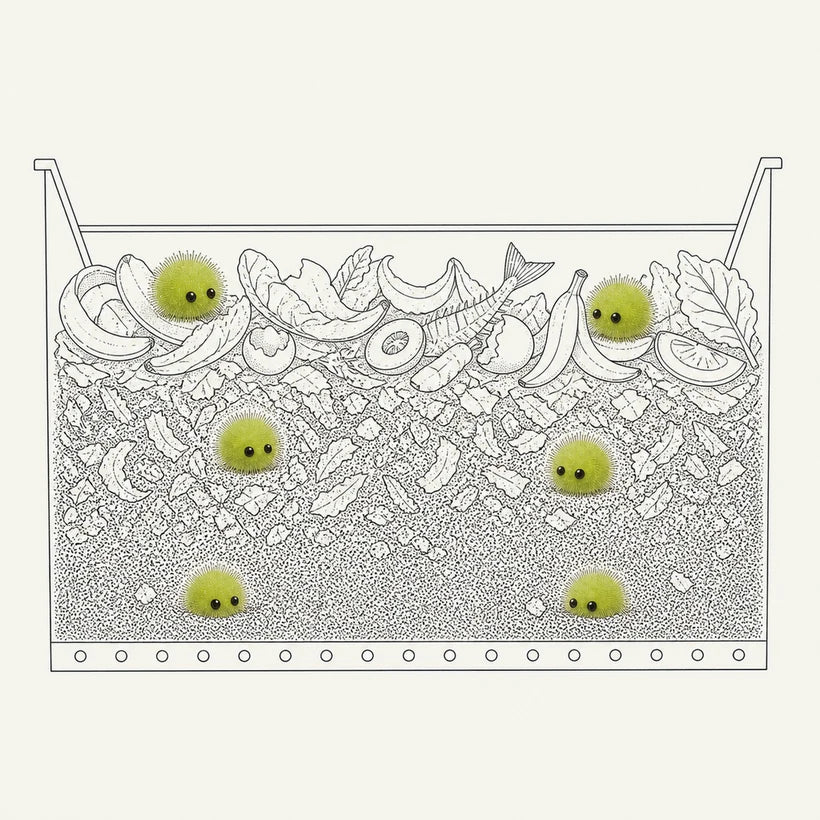


The bed, between loads.
What actually happens
Inside the chamber there is a live culture of microbes. We grow it ourselves and call it Speedozyme™: a mix of bacteria, fungi and yeast — Bacillaceae, Mucor, yeast, thermophilic and mesophilic groups. The culture is supplied with the machine.
The culture can survive from −20 °C to 75 °C; its working range is 25 °C to 65 °C. It tolerates a pH range of 4.0 to 9.0. The starter is included when the machine is commissioned. You do not add sawdust, and you do not add rice husk. That is one of the real differences between this and a garden heap.
Between loads the culture stays in the chamber and keeps working. The culture is maintained as part of the service programme. The bed stays in the machine and you feed it.
No sawdust. No rice husk. No bulking agent to order or store.

Everything a kitchen stocks is on the rack. The bay where a bulking agent would sit is empty, because the culture is already in the machine.
What it means on your floor.
No sawdust, no rice husk, no bulking agent in the store room — and so no line for one in the running cost.
The starter is already in the machine. Follow the operating instructions for your model. The procedure at the machine is: open, tip, close.
We supply and service the culture as part of the maintenance programme.
Keeping the culture working.
- Ask for the top-up schedule and what it costs. We service Speedozyme as part of the maintenance programme. Ask us for the top-up interval and the cost per month in writing, per model, before you sign.
- −20 °C to 75 °C is where the culture survives, not a promise about your room. The working band is 25–65 °C. The 70 °C hold in step 04 is a machine-controlled stage of the cycle, not the temperature the culture lives at.
- Alive means it can be harmed. Bleach and sanitiser are on the never list for this reason, not only for the compost. A sanitiser rinse tipped in with the scrape works against the machine. So does a heavy oil load: it slows the culture down. That is step 05.
Nothing to shelve — one thing to get in writing.
There is no sawdust or rice-husk requirement. Culture servicing and other running costs depend on your model and service agreement. Ask us about the culture service interval for your model. Our acceptance guide explains what to keep out of the chamber.